Please note that Steveston Tram is closed on November 11 for Remembrance Day, as we honour the sacrifices of Canada’s service personnel, past and present.
Wartime Metro Vancouver: Trams Kept the Region Moving
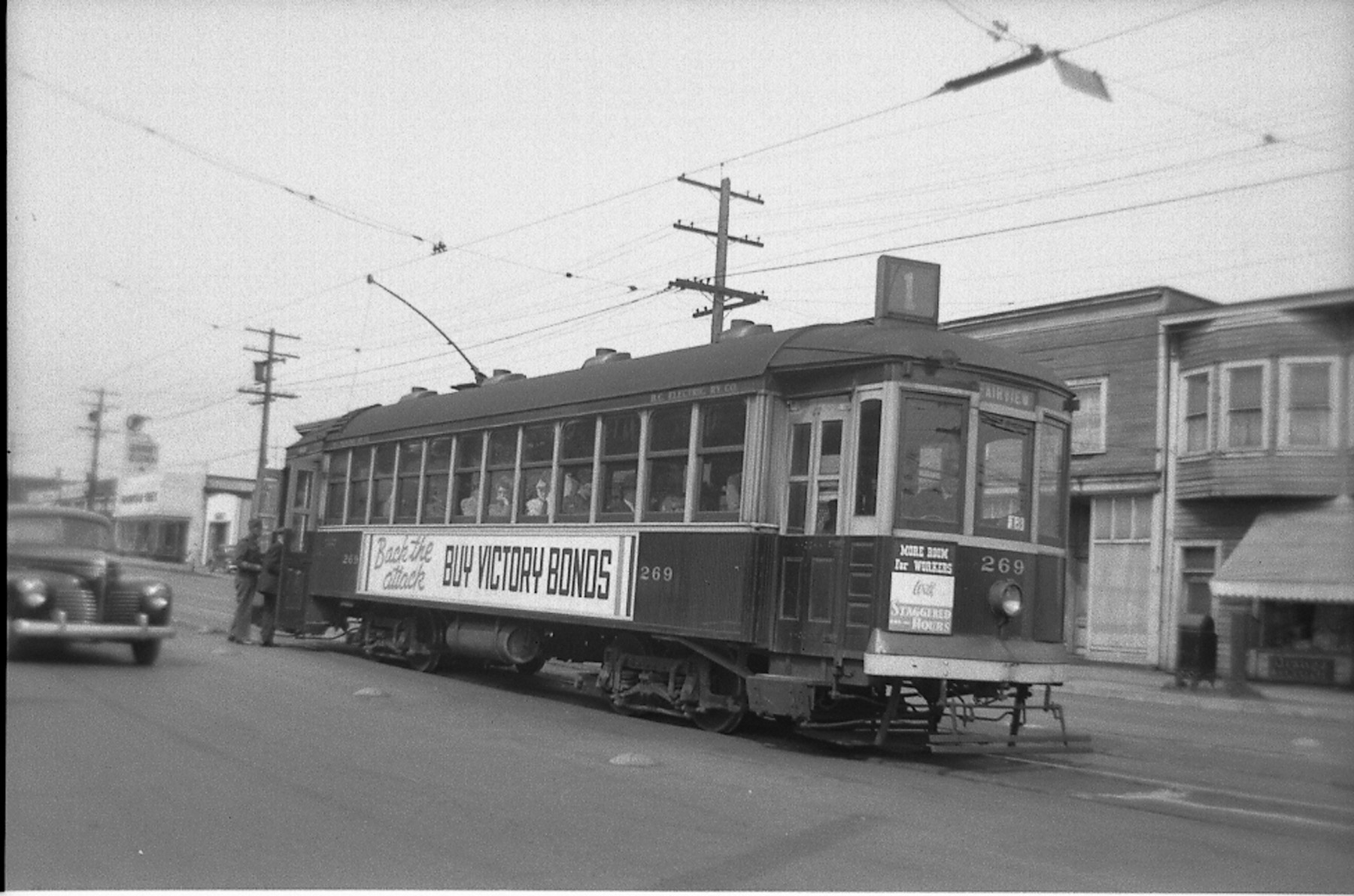
If you look closely at the above photo, you may spot a soldier boarding Streetcar 269 at Broadway and Commercial Drive in Vancouver in 1942, during the Second World War.
At first glance, it may seem like an ordinary scene from wartime Vancouver. But this single photograph tells several stories, including one about the essential role public transit played during the war.
Look at the road. Apart from the streetcar, there is only one motor car in sight. A street that would normally have been busy with traffic is almost empty. Why?
Wartime Gasoline Rationing
In 1942, the Canadian government introduced gasoline rationing as part of its wartime measures. Fuel was a vital resource, and restricting civilian consumption helped conserve supplies for the war effort.
The rationing system, administered by the Department of Munitions and Supply, required motor vehicle owners to obtain a licence to purchase gasoline. Vehicles were assigned both a category and a class. The category reflected how essential the owner’s employment was considered to the war effort, while the class was based on the vehicle’s make and model.
Each vehicle was allotted a maximum number of gasoline units per year based on this license, with each unit equivalent to five gallons. Car owners were then issued books of ration coupons based on the allotted units.
Public Transit’s Heyday
With gasoline and tires rationed, many Canadians had fewer options for travelling by private vehicle. Meanwhile, factories, shipyards, and aircraft plants were working to meet wartime demands, and troops needed to be transported across cities and across the country. Public transit became more important than ever.
By the mid-1940s, the BC Electric Railway was one of Canada’s largest interurban and street railway systems. Its extensive network connected communities across the Lower Mainland, helping workers reach their jobs and keeping people moving at a time when transportation was essential to the war effort.
This photograph captures more than a soldier boarding a streetcar. It reminds us how wartime restrictions changed everyday life and how public transit helped keep communities moving when the country needed it most.
Sources:
ArchivesCanada.ca Gasoline ration coupons – ArchivesCanada
Henry Ewert, The Story of the BC Electric Railway Company, Whitecap Books, North Vancouver, 1986.